I have recently been thinking about the idea of freedom and how it applies to the bible. It seems to me that the freedom God is supposed to give is not as open ended as it seems. Freedom is the right to do what you want when you want withing the bounds of common sense and basic human rights, like the right to life. In many places in the Hebrew Bible it seems like God is giving the Jews freedom but to me it seems more like God is giving the Jews conditional freedom, rather than unconditional freedom.
One of the biggest examples of this is when God frees the Jews from Egypt. At first glance it seems like God is freeing the Jews entirely and without reserve. But when you look closer you find that everything is not quite as it seems. Firstly, God waits a very long time before actually freeing the Jews. It is quite obvious, from what He has done in the past, such as destroying Sodom, and causing the great flood, that He could have just waved his hand and with very little effort, freed the Jews much sooner than He did. It seems like He waited so that the Jews would be in enough despair that they would do what he asked without questioning it at all. After He gets them out of Egypt he then starts to lay down laws that everyone has to follow. While the ten commandments do seem like just a restatement of basic human rights, the laws he puts forth after that are all about exactly how one should live. These laws effectively control the Jewish people and seems just like another form of slavery.
I do not know if this is right but with everything that is happening in the government these days it bears to keep this in mind.

Showing posts with label Exodus. Show all posts
Showing posts with label Exodus. Show all posts
Saturday, May 13, 2017

Sunday, March 5, 2017
Plots
Zornberg’s
excerpt about God’s plot was surprising to me. Through the midrash example, it
seemed like God was punishing humans before they did anything wrong. Their fate
was predetermined, just like the man who had decided before he even walked into
the kitchen that he would hand his wife divorce papers. If there is no way to
change our fate, if we are just living into God’s plot for us, as the midrash
author is starting to imply, what is the point of living?
I
believe this is an overly dark way of viewing the bible. If this is true, what
is the point of serving God if there is a predetermined fate? What value is
there in following God’s commandments and rules if there are no decisions to be
made? All humans die at a certain point, but when it is discussed in this
context, it seems particularly dark. It makes humans sound like pawns in God’s
plan.

The
main reasoning behind why this would be God’s plot that occurs to me,
admittedly not omniscient, is so that the world can function as a natural
system. But if this is God’s plot, why do some people suffer? If he has
designed everything, why did God not design it to be perfect? This pessimistic
view makes it seem like God is a dark force. If he has predetermined not only
the pieces on his earth but also each and every decision they will make, he
controls all of life. This midrash makes me glad my view of God is less dark.
Wednesday, February 22, 2017
International Relations and the Bible
"Come on, let us deal wisely with them; lest they multiply, and it come to pass, that, when there falleth out any war, they join also unto our enemies, and fight against us, and so get them up out of the land." Exodus 1:10
This quote from Exodus because of the political situation it proposes. This is the pharaoh of Egypt that knows not of Joseph and so he severely misunderstands the Jewish people under his rule. He wishes to stop their expansion because he is afraid that they will eventually find an enemy nation and attack Egypt with this outside force. The Israelites are getting too big and their growing numbers represent their growing power that can and will be realized by the children of Abraham violently. Their population expansion can be seen in the modern context as a rising economic power like that of modern day China. The Israelites represented the potential for conflict, like in the eyes of many Americans and International Relation theorists, the economic might of China can and is being translated into military power. This military power is seen as a threat to the power of the United States and is the reason why some believe a conflict with China is eminent. But can we learn something from the situation of pharaoh and the Israelites?
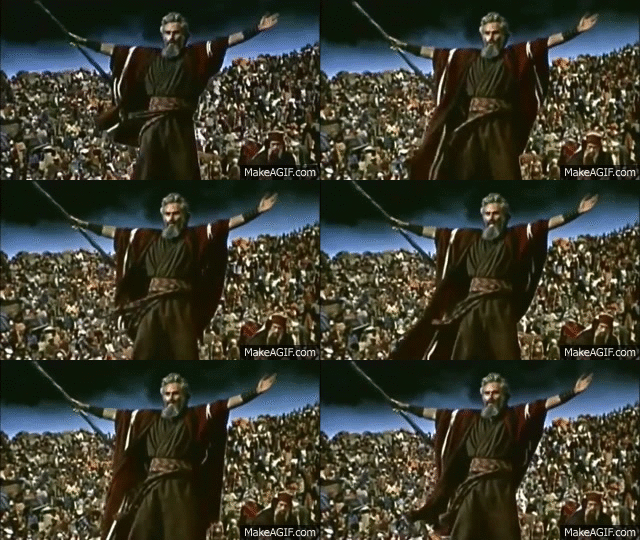 "lest they multiply", Pharaoh should know that this is an inevitability that these people will multiply, its God's divine will, they're his chosen people, there is even a covenant between these people and this non-human entity. As Exodus tells us, "Now there arose up a new king over Egypt, which knew not Joseph" Ex 1:8, so obviously he is completely unaware of the agreement and the divine choice and the promise. He is completely under informed about the enemy he is naming, sounds like an American President who could have been a burning Bush if one's pants actually lit on fire when one lies. A common problem between leaders is not knowing your enemy, which we know is a grave mistake, as Pharaoh learned with his relationship with Moses and as America learned with our endeavors in the Middle East (and Vietnam).
Know your enemy. The United States should ensure its well informed on a Chinese enemy if they choose to make China an enemy. That is they should be well informed on China's view of themselves in the international system. As well as understand Chinese culture and traditions; lest America try and punish them, like pharaoh who, "made their lives bitter with hard bondage"Ex 1:14, and then when that didn't work ordered the genocide of Jewish males. If the U.S. trys to enact a modern day punishment against the rising power, like economic sanctions to try and deter the Chinese economy, the equivalent to the hard labor and murder of Jewish children ordered by pharaoh, then America might end up with a stronger China than before, like the Egyptians saw with Israelites.

This quote from Exodus because of the political situation it proposes. This is the pharaoh of Egypt that knows not of Joseph and so he severely misunderstands the Jewish people under his rule. He wishes to stop their expansion because he is afraid that they will eventually find an enemy nation and attack Egypt with this outside force. The Israelites are getting too big and their growing numbers represent their growing power that can and will be realized by the children of Abraham violently. Their population expansion can be seen in the modern context as a rising economic power like that of modern day China. The Israelites represented the potential for conflict, like in the eyes of many Americans and International Relation theorists, the economic might of China can and is being translated into military power. This military power is seen as a threat to the power of the United States and is the reason why some believe a conflict with China is eminent. But can we learn something from the situation of pharaoh and the Israelites?
Know your enemy. The United States should ensure its well informed on a Chinese enemy if they choose to make China an enemy. That is they should be well informed on China's view of themselves in the international system. As well as understand Chinese culture and traditions; lest America try and punish them, like pharaoh who, "made their lives bitter with hard bondage"Ex 1:14, and then when that didn't work ordered the genocide of Jewish males. If the U.S. trys to enact a modern day punishment against the rising power, like economic sanctions to try and deter the Chinese economy, the equivalent to the hard labor and murder of Jewish children ordered by pharaoh, then America might end up with a stronger China than before, like the Egyptians saw with Israelites.

Wednesday, February 15, 2017
Cult Classic
I find rereading Exodus unexpectedly interesting.
It struck me that the Lord in Exodus is giving all of these rules all his
followers should obey. They sound like ultimatums. “If you don’t do this, this will happen...” It threw me off: it
made me feel like Christianity was cultish WHILE reading the Bible. The little
things were made sound so black and white—life or death. To be close to God, in
my experience, I understand following a proper, Christian way of living is
good. You do not, however, have to do everything right in order to be a good
Christian.

One
of the themes that made me keep thinking about this is how all the people, after
being given the Ten Commandments, get frightened by the thunder and lightening
from the mountain. They are able to express this to Moses: “Speak to us
yourself and we will listen, but do not have God speak to us or we will die”
(Exodus 19:16). In a cult, there is generally one leader whom everyone is
scared of and will do anything to make happy. Hearing how terrified the people
waiting for God’s commandments are is disturbing.
The
way God is speaking in the Bible would be less accepted, at least in most of America
and the European world because people have more rights and choice today. Today
there is more choice in what an individual can do or say he or she believes. I
think this is a good thing; it allows people to be themselves more. This, I
think, means that faith is able to be more truthful today. For me, I feel
guilty when I do something that I “shouldn’t” do as a Christian, but I am not
worried about the threat of death. If I was worried that I might die as a
result of my actions, I would likely be more scared and more of a “perfect
Christian” simply because I am scared instead of this being a result of my
beliefs.
Thursday, February 9, 2017
Now vs. Then
Having read the Hebrew bible again recently, I am reminded that the way the we were told to do things like celebrate were different from the way we celebrate now.many of the celebrations the Jewish people were told to have are still celebrated today but in a different way.


Passover is one of the celebrations that has changed and evolved over time. In the bible we are told to celebrate the freeing of the Hebrews from Egypt but we are only told this in vague terms, "For seven days you are to eat bread made without yeast." (Exodus 12:15). Now, however, we celebrate this with Passover. Passover is a seven night celebration of the freeing of the Hebrews. Many of the things we are asked to do in the bible are the same today, such as during Passover, we only eat unleavened bread. But many things have been added. One addition is to leave out a cup of wine for the prophet Elijah and leave a door cracked open so he may enter the house. another addition to the celebration is reciting of the words of the four children.
Another celebration that has changed is Shabbat. Shabbat is the celebration of the Sabbath on Friday nights. In the Bible we are told to rest and not do any work on the Sabbath, "but the seventh day is a sabbath to the LORD your God. On it you shall
not do any work, neither you, nor your son or daughter, nor your male or
female servant, nor your animals, nor any foreigner residing in your
towns" (Exodus 20:10). The way the sabbath is celebrated is very different. We still do no work, but we have a special dinner to celebrate the sabbath. We eat a special bread called challah, and we light candles and drink a ceremonial cup of wine.
We have thousands of years of history and that has caused us to change the way we partake the celebrations and ceremonies described in the bible. It gives one the feeling of being involved in the way we interpret the bible.
We have thousands of years of history and that has caused us to change the way we partake the celebrations and ceremonies described in the bible. It gives one the feeling of being involved in the way we interpret the bible.
Tuesday, February 7, 2017
Whose narrative? Repetition and non-repetition of Pharaoh's hardened heart, in the Torah and now

The original experience of the signs and miracles may have been overwhelming. But when the Torah repeatedly urges their transmission to the future, in the form of narrative, triumphant simplicities disappear in the dazzle and blur of memory. The question arises: "Whose narrative?" (Avivah Zornberg, The Particulars of Rapture: Reflections on Exodus)
I have been thinking a lot lately about how one deals with people who seem impervious to communication or paying attention to data that might change their minds, or as the Torah puts it, whose "hearts are hardened." Last week, the weekly Torah portion read in Jewish synagogues was chapters 10-13 of Exodus, which covers the last few plagues when Pharaoh's heart is hardened, explicitly by God, as well as the first Passover laws intended to keep the Israelites from suffering the plague of the death of the firstborn. Among these laws is the command to tell this story to future generations of Israelites. Avivah Zornberg, in her commentary to Exodus, discusses this, and suggests that the Biblical narrative includes a kind of subversive subtext of narrative, a way of saying you shouldn't necessarily believe exactly what your eyes have seen (or what your ears have heard). There might be multiple ways of interpreting the events before your eyes - the signs and wonders God accomplished in the Egyptians and Israelites, right before their eyes. Though not right before the eyes of subsequent generations of Israelites, that is, "your child who will ask" what the laws instituted in Ex 12-13 mean. The narrative non-repetitions in the story of the plagues open other possible interpretations.
There are discrepancies and non-repetitions in what, how, and why God says specifically about Pharoah's heart being hardened. In Ex. 7:3-5, the Lord says:
But I will harden Pharaoh’s heart, and I will multiply my signs and wonders in the land of Egypt. 4 When Pharaoh does not listen to you, I will lay my hand upon Egypt and bring my people the Israelites, company by company, out of the land of Egypt by great acts of judgment. 5 The Egyptians shall know that I am the Lord, when I stretch out my hand against Egypt and bring the Israelites out from among them.
In Ex. 10:12, before the 8th plague of the locusts, the Lord says,
Go to Pharaoh; for I have hardened his heart and the heart of his officials, in order that I may show these signs of mine among them, 2 and that you may tell your children and grandchildren how I have made fools of the Egyptians and what signs I have done among them—so that you may know that I am the Lord.It's not just for the Egyptians to to know, but also so that you - Israelites, including your children and grandchildren- "may know that I am the Lord" - by telling them how He made fools of the Egyptians.
Not exactly what God said earlier.
Moreover, did God Himself harden Pharaoh's heart, or did he harden it himself? Certainly God predicts that he will harden Pharaoh's heart, but does that mean that God was directly responsible for every instance that Pharaoh's heart was hardened? The narrative offers a mixed message: sometime Pharaoh himself, sometimes God hardened it. For the first five plagues, it seems to be Pharaoh himself. Pharaoh is the subject of sentences referring to his hardening his heart; it doesn't say explicitly God hardened it, i.e., 7:22: after the blood plague, "Pharaoh remained obstinate (as the Lord had foretold)"; after the frogs, "he became obdurate as the Lord had foretold;" after the lice, 8:19: "Pharaoh remained obstinate (as the Lord had foretold); and so on after the swarms of flies (8:32), the plague of the animal disease (9:12). Only after the plague of hail, while at first it says Pharoah remained obstinate (9:35), does it say explicitly (with God speaking), that "I have made him [Pharaoh] and his courtiers obdurate" (Ex 10:1), and then after the plague of locusts, "The Lord made Pharaoh obstinate" (10:20), after the plague of darkness, " "the Lord made Pharaoh obstinate" (10:27; 11:9).
So does this break in the pattern suggest that Pharaoh at least at first had free will, and only later did God make him harden his heart? Or did God's foretelling it make it so, as a sort of self-fulfilling prophecy? The non-repetition makes us question who's pulling Pharaoh's strings, or when? Also, in several of Pharaoh's refusals to let the Israelites go, he first assents (sometimes with conditions unacceptable to Moses), and then changes his mind. That sounds more like a flexible, rubbery heart, not an inflexible heart of stone - despite the fact the text says Pharaoh's heart was "hardened."
So this is one set of particularly significant breaks from the repeated pattern of "plague followed by Pharaoh's heart-hardening." This break also parallels more or less another break - plagues affecting all of Egypt, vs. plagues specified as affecting only the Egyptians, and sparing the the Israelites. That sets up the last big break from the pattern, God's legislation of the Passover laws in Ex 12 between the 9th and last plague killing the Egyptians' first born sons. By observing those laws, by doing that actions commanded by God, the Israelites will be be spared from the fate of having their first born sons killed unlike the Egyptians; God will "pass over" the Israelites' homes. An interesting and notable connection between narrative and law in the Torah! The laws have a function in the narrative - to break the pattern and to advance the plot!
OK - so much for the details. The big question is what's the point of these repetitions and breaking the pattern? I think it's to address the the bigger question, the one I began with - how do we explain and how do we deal with people like Pharaoh who are impervious to persuasion and change, and who seek to harm us? The Torah "answers" this by basically having God set Pharaoh up, staging a performance in which Pharaoh thinks and acts as if he's in control, but he's really not. God plays him like a puppet, and shows him to be a self-deluded fool before the eyes of his Egyptian subjects, and before the eyes of the Israelites. Pharaoh doesn't really ever have to be convinced decisively to change his mind, since he is overcome by events, regardless of his intentions. God uses Pharaoh's intransigence to make a point, a point made not only to the the Egyptians and Israelites at the time, but to subsequent generations of Israelites, by commanding the Israelites to tell and retell the story of what God did for them and to Pharaoh and the Egyptians.
But at what cost? A lot of innocent Egyptians had to suffer because of the hard-heartedness of their ruler; their animals and land devastated, a lot of dead first-born sons! All to make a point!? What kind of God does this? What kind of people worship and serve a God who would do this? The narrative raises as many questions as it "answers." The holes in the narrative, the discrepancies, the repetition/non-repetitions leave room for these questions. And so does the command to tell the story in subsequent generations, because each retelling has to confront anew these questions, gaps, discrepancies. We see and embrace both the patterns and the breaks from the patterns. The Torah text leaves room for subversive narratives, different ways of telling "the same story."
And the new circumstances in which we retell the old stories also bring out new resonances, new meanings. What do you think of now, when you hear the story of the heart-hardened Pharaoh, impervious to persuasion, to facts, to the advice of his advisors, to the suffering of his own subjects, and to the suffering of the Others in his midst?
Subscribe to:
Posts (Atom)